Sunday, 26 February 2012

Sir Peter's Latest Proper Pickle

Sir Peter Housden, the Scottish  Government's Permanent Secretary, has a knack of attracting headlines.
In today's Sunday Herald, we reveal his candidly brutal assessment of Andrew Lansley's NHS reforms south of the border.
GP commissioning, which is at the heart of the scheme, is "a solution to no known problem," says Sir Peter, going on to describe it as "enormously risky".
Doubtless, David Cameron and his Health Secretary will be delighted.


EXCLUSIVE
Tom Gordon
Scottish Political Editor

SCOTLAND’S top civil servant last night sparked a cross-border row after a video emerged of him deriding the Coalition’s controversial NHS reforms and calling their core idea “enormously risky”.
 

Permanent Secretary Sir Peter Housden told Scottish NHS managers that Tory Health Secretary Andrew Lansley “could not persuade anyone” that having GPs commission patient care in England instead of health trusts was what was needed to improve the health service.
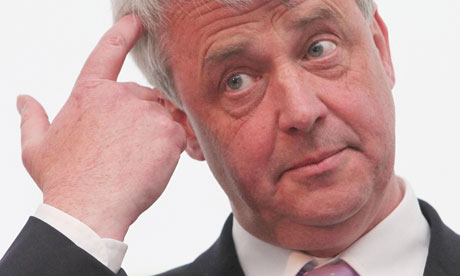
Andrew Lansley: "enormously risky"

The £180,000-a-year mandarin, who as part of the UK civil service is supposed to be politically neutral, suggested Lansley lacked a clear "story" about why the changes were needed, and had failed to identify what actions to take.
Housden referred dismissively to GP commissioning, the central plank of the beleaguered Lansley reforms, as “a solution to no known problem”.
Contrary to David Cameron’s pre-election promise not to impose top-down reorganisation, the NHS plan was “such a big set of reforms it can be seen on an inter-galactic basis,” he joked.
The remarks are hugely unhelpful to Lansley and David Cameron, who are struggling to sell the reforms to health professionals, and who face a revolt from LibDems in the Coalition.
The comments were made in November in a training seminar called “Stands Scotland where it did?” which has been put online by the Scottish NHS.
In it, Housden said the Scottish Government had developed a seven-point test for new policies called “Changing the World”, which asked if they had vision, a recognisable story, clear actions, and other necessary qualities.
Applying the test to the Coalition’s NHS reforms, he said Lansley got “a tick” for a vision of a world class health service free at delivery.


Sir Peter Housden, again
But he went on: “Thereafter Mr Lansley got into a bit of trouble. Had he got, secondly, a story to enable people to recognise where the NHS south of the border had been and where it was going?
“And thirdly, could they recognise a set of actions that would help move them forward?
“Now here we come to GP commissioning - a solution to no known problem.
“Mr Lansley could not persuade anyone, actually, [that] the things that they perceived needed to happen in the NHS would be resolved by GP commissioning. People could see some of that argument, but actually to base a system on all of that seemed to be enormously risky.”
The comments last night led to fresh criticism of Housden, who is already facing claims of “going native” by being too close to Alex Salmond.
Last year, the Scottish leaders of the Labour, LibDem and Tory parties complained to the UK Cabinet Secretary about Sir Peter’s apparent enthusiasm for independence.
In his November talk to the NHS managers, Sir Peter suggested people had voted SNP because they were ambitious for Scotland.
“I think the election result affirms a high level of ambition, a population that wants to see Scotland move forward.”
Sir Peter also said the SNP government was behind “the biggest programme of social reform in Scotland ever... certainly since the Second World War” and told the civil servants: “If you’re not enjoying this, you’re in the wrong job really”.
Tory MSP Murdo Fraser said: “Sir Peter Housden has already got into trouble for crossing the line of what is acceptable behaviour for a civil servant, and now he appears to have exceeded himself.
“Senior civil servants should not be expressing views on party political matters north or south of the border. Once again, Scotland’s most senior civil servant is exposed for being far too cosy with Alex Salmond’s separatist agenda.”
But Scottish Labour leader Johann Lamont said: “I think on this issue Peter Housden has caught the mood of people not just in Scotland, but across the whole of the UK.
“The Tory reforms would be a disaster for the NHS. “With doctors, nurses, surgeons, specialists, patients and even half his party against the reforms, this is another nail in the coffin for Andrew Lansley’s plan to break up the NHS.”
A Scottish Government spokeswoman said:
“Sir Peter's participation in a seminar for NHS managers is hardly surprising.
“A key part of his role as head of the Scottish Government Civil Service is to discuss important issues in public policy. On this occasion he was illustrating the Scottish Government's approach by contrasting it to the very different nature of NHS reform elsewhere in the UK.”

Monday, 12 December 2011

Bills, bills, bills

The SNP's 'anti-sectarianism bill' returns to Holyrood for its third and final stage on Wednesday. 
It has been heavily and widely criticised, leading to some re-writes from the government, such as the addition of a freedom of speech section. 
Now the minister in charge is putting down some eleventh-hour amendments suggesting there are still serious problems to fix. 
Here's a longer version of my story in the Sunday Herald.

EXCLUSIVE
Tom Gordon
Scottish Political Editor

THE SNP are set to water down their controverisal bill aimed at tackling sectarianism in football.

Community Safety minister Roseanna Cunningham, who is taking the legislation through the Scottish Parliament, has tabled a last-minute amendment which would let her scrap a key section which had previously been likened to “thought crime”.

She has also tabled an amendment narrowing the scope of those outside Scotland who could be punished by the bill, a tacit admission that the original version strayed beyond devolved powers.

MSPs vote on the third and final stage of the Offensive Behaviour at Football and Threatening Communications (Scotland) Bill on Wednesday.
Labour, the Tories, LibDems and Greens say it is muddled and unnecessary, but it is set to become law regardless thanks to the SNP’s majority.
Prompted by the violence centred on the Old Firm last season, the bill criminalises religious, racial or homophobic bigotry at football games, as well as sectarian threats on the internet.
As it stands, the bill could see football fans jailed for up to five years for behaviour “likely to incite public disorder” even if no one else was offended and no disorder occurred.
For instance, Section 1(5)(b) would criminalise abusive chanting in supporters’ clubs where only one set of fans was watching a televised match, or at a stadium where one team’s fans had already left. 
Holyrood’s justice committee queried the concept, but Cunningham said it was “essential” the bill emphasised such behaviour was always unacceptable.
As recently at November 22, Cunningham told the Justice Committee that without it. bigots would have “the freedom to take their poisionous singing and chanting into pubs and clubs across the country when there are football broadcasts. That cannot be tolerated.
However, her new amendment would give ministers the power to “disapply” this part of the law using minor legislation, clearing the way for a quick U-turn if the law proves unworkable.
Section 4A 
Roseanna Cunningham 

3 In section 4A, page 4, line 18, at end insert— 
<(  ) disapply paragraph (b) of subsection (5) of that section in relation to a 
description of behaviour for the time being listed in subsection (2) of that 
section,> 
Cunningham has also tabled an amendment narrowing the scope of those punishable under the bill.
Currently, it applies to any British citizen or Scottish resident who incites disorder at a match outside Scotland involving a Scottish side.
Cunningham now wants to drop all reference to British citizens, meaning only Scottish residents guilty of behaviour outside Scotland are covered.

Section 7 
Roseanna Cunningham 

4 In section 7, page 7, line 8 leave out <, sections 1(1) and 5(1) also apply> and insert <by any 
person, section 1(1) also applies> 
Roseanna Cunningham 

5 In section 7, page 7, leave out lines 10 to 13 
This effectively exempts ex-pats and Rangers and Celtic fans in Northern Ireland who misbehave in relation to Scottish matches outside Scotland.
Anyone committing an offence while they are in Scotland would still be liable to punishment.

Alison McInnes, the LibDem justice spokeswoman, said: “These amendments show the government knows they’ve got it badly wrong - they just aren’t willing to own up. Instead, we have desperate attempts to find a way out, to surreptitiously ‘disapply’ parts of the bill at a later stage.
“The other amendment is an embarrasing admission that the attempt to apply the crime to other British citizens is far outwith their powers.
“The only sensible way out of this mess is to put this bill through the paper shredder.”
A Government spokesman said: “Supporters clubs would be fully covered by the legislation. It [the amendment] simply gives the power to add to or amend the offence in the future. However, we have absolutely no plans to invoke this power.”
Labour will today launch an anti-sectarian action plan aimed at tackling religious hatred in sport and across society as an alternative to the bill.


Sunday, 11 December 2011

In the red corner

There's more trouble at the City Chambers, as Glasgow Labour continue to fight among themselves instead of focusing on the SNP threat ahead of May.
Here's a longer version of the story in today's Sunday Herald.


EXCLUSIVE
Tom Gordon and Paul Hutcheon

THE most high-profile Labour politician in next year’s council elections has been accused of threatening one of his party colleagues, the Sunday Herald can reveal.

Gordon Matheson, the leader of Glasgow City Council, is the subject of a complaint to the country’s independent watchdog for councillors.

He has been reported by fellow Glasgow Labour councillor Tommy Morrison, who claims he was threatened with the loss of a £11,000-a-year post at Strathclyde Fire & Rescue unless he helped an ally of Matheson get re-selected as a Labour candidate.

The complaint is a blow to Matheson, who has faced continued Labour infighting at the City Chambers since he replaced boss Steven Purcell last year.
After their landslide win at Holyrood, the SNP made May’s local elections their next priority, with Glasgow the main prize.
Matheson’s high-pressure job is to defend the city, where Labour has 47 of the 79 councillors.
The SNP last night said the Morrison complaint had exposed panic and indiscipline within Glasgow Labour as the election approached.
Central to Labour’s election strategy has been a recent clear-out of so-called ‘deadwood’ councillors, and the selection of new candidates.
The purge led to almost half the party’s sitting councillors in Glasgow failing candidate vetting, effectively ending their political careers.
The result has been an angry backlash against Matheson and his chief whip Alex Glass.
Morrison, a councillor in the Greater Pollok ward since 2007, was among those who failed vetting.
His complaint concerns the lead up to a meeting of Greater Pollok Labour branch on November 24, which was due to select two candidates for May.
The ward currently has three Labour councillors - Morrison, Willie O’Rourke and Alex Glass.
With Morrison deselected and O’Rourke suspended, only Glass was eligible to stand for re-selection.
Morrison claims he was warned before the meeting that if he interfered with Glass’s bid, or failed to support him, he would lose his council-related place on Strathclyde Fire Board, which last year carried an allowance of £10,978.
It is understood Morrison discussed the issue face to face with an “agitated” Matheson, in the latter’s office at the City Chambers.
Morrison complained to the party hierarchy, and he and Matheson allegedly reached a brief truce.
However Morrison has now complained to the Public Standards Commissioner about the episode, and copied Labour HQ into the correspondence.
A friend of Morrison told the Sunday Herald: “Tommy made a complaint to the Standards Commission against Councillor Matheson. Cllr Matheson told Tommy that if he interfered with the selection of Alex Glass, he would be removed from the Fire Board. Tommy could not accept a threat to democracy in any shape or form.”
In the end, Glass lost the Pollok selection, as local members, including many of Morrison’s supporters, voted for former Anniesland MSP Bill Butler and newcomer Rashid Hussain instead.
Glass is understood to have been gutted at his defeat, which was also interpreted as a slap in the face for Matheson.
Glass is now trying to get selected in a new ward, with rumours circulating within Labour that party bosses will try to parachute him into Springburn.
Graeme Hendry, the SNP’s chief whip on the council, said: “This latest bout of infighting is yet another indictment of the lack of leadership, vision and discipline within Glasgow Labour.
“Any party which tried to control colleagues through intimidation and bullying would not be fit to lead a great city.”
A spokesman for Cllr Matheson said: “Allegations that Gordon Matheson threatened any member of the Labour group are completely untrue.”
Cllr Morrison declined to comment.